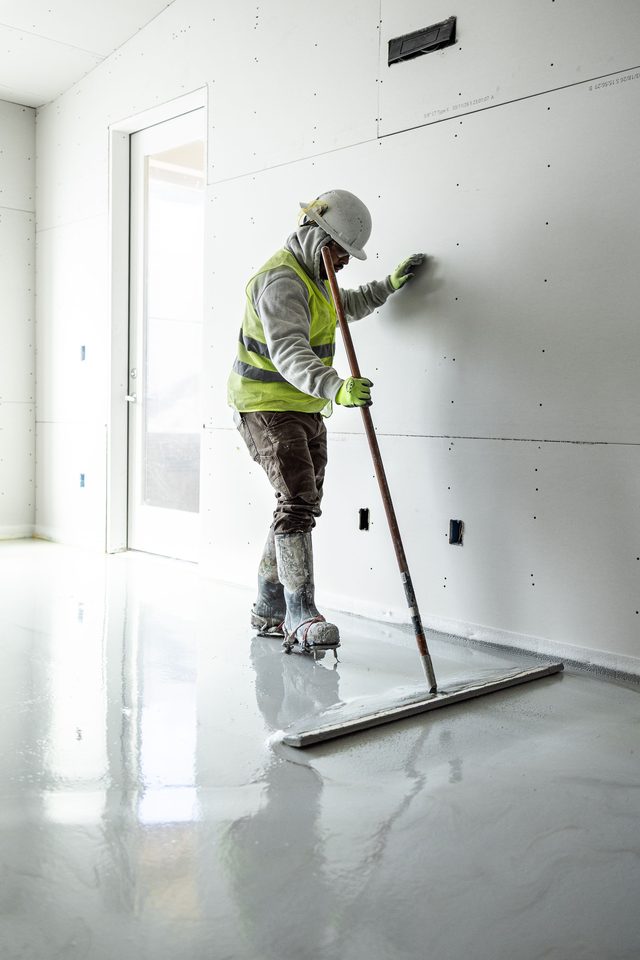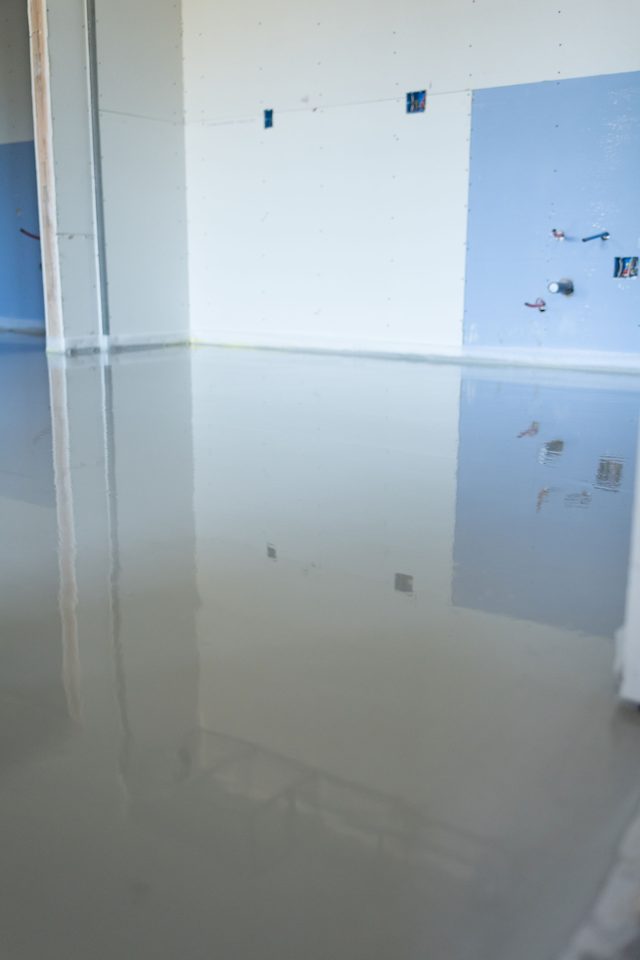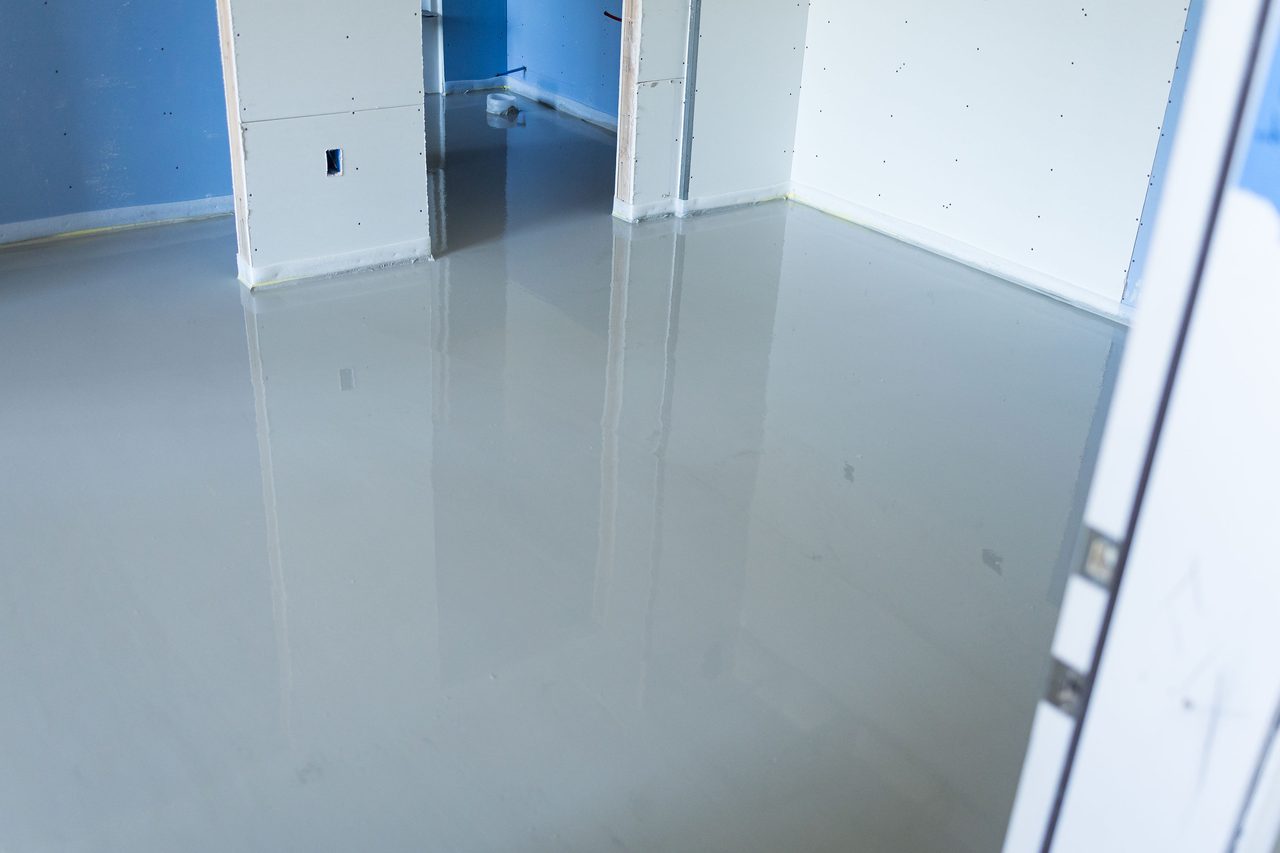
Flatness. Tolerance. Warranty.
Modern finish flooring is intolerant. LVP manufacturers commonly require flatness on the order of 3/16″ in 10 feet; large-format tile is stricter. Miss the tolerance and the symptoms arrive on schedule: clicking plank joints, lipped tile edges, telegraphed ridges under sheet goods — and a flooring warranty claim that gets denied because the substrate was out of spec. Substrate flatness is the flooring installer’s first escape hatch. Take it away.
Self-leveling underlayment is the fix: a fluid cementitious or gypsum-based topping that seeks its own level across dips, crowns, worn slabs, and transition mismatches, then cures to a hard, flat, bondable surface. Poured from featheredge up to several inches, it turns a battered slab into a substrate the flooring manufacturer will stand behind.
Old Slabs. New Tenants. Tight Turnovers.
Commercial fit-out and renovation is where leveling scope hides. Demo the old flooring in a retail shell or office floor and you inherit decades of history — adhesive residue, patch jobs, trenching scars, elevation changes at every former wall line. The tenant’s opening date does not move. We resurface and level these floors as a dedicated scope: mechanical prep, repair of spalls and joints, then a self-leveling pour that resets the whole floor plate to one plane. Concrete repair for commercial up-fit and resurfacing of finished concrete floors are core services, not sidelines.
Radiant heat encapsulation is the other half of this page. Hydronic radiant tubing stapled to a subfloor needs full encapsulation in a thermal topping — typically 3/4″ to 1.5″ of gypsum-based material over the tube. Done right, the topping locks tubes in place, spreads heat evenly across the floor, and adds fire and sound mass in the same pour. Done wrong — over-watered, poorly consolidated, voids around tubes — you get cold stripes, cracked toppings, and a floor that has to be opened up. Our computer-batched pours put the topping down at consistent, specified water content, which matters twice over radiant tubing: consistent density for even heat transfer, and predictable dry-down before the flooring goes over it.
Fit-Outs. Renovations. Radiant Floors.
- Self-leveling underlayment over concrete and wood substrates, commercial and multifamily
- Concrete resurfacing of worn or damaged finished floors
- Concrete repair for commercial up-fit — spalls, joints, trench patches, elevation transitions
- Floor toppings for radiant heat installation — full tube encapsulation
- Featheredge transitions and ramping between finish floor types
- Renovation and adaptive-reuse floor packages, coordinated with our sound-control and underlayment scopes